News

Latest updates from the public health leadership front lines
Apr 19, 2021
by
SHLI Team
Watch "The Allegory of the Orchard" By Daniel E. Dawes Come To Life!

SHLI premiered a two-part animated series of "The Allegory of the Orchard," an excerpt from Daniel E. Dawes' book The Political Determinants of Health, illustrating barriers faced by racial and ethnic minority communities and the importance of addressing political determinants.

Mar 23, 2021
by
SHLI Team
The Rotary Club of Buckhead Honors Dr. David Satcher with the Rev. Robert Ross Johnson Humanitarian of the Year Award

Dr. David Satcher received the prestigious Rev. Robert Ross Johnson Humanitarian of the Year Award from the Rotary Club of Buckhead, recognizing his medical and educational accomplishments and profound impact on health equity throughout his career.

Feb 22, 2021
by
SHLI Team
AMA-SHLI Launch Fellowship Program to Confront Health Inequities

The American Medical Association and the Satcher Health Leadership Institute at Morehouse School of Medicine announced a collaborative fellowship to empower physician-led advocacy that advances equity and removes barriers to optimal health for marginalized communities, with applications due March 31, 2021.

Feb 10, 2021
by
SHLI Team
Building A Better 'normal'

This insightful op-ed by Daniel E. Dawes and Brian C. Castrucci highlights the need to continue advancing health equity post-COVID-19 pandemic through systemic policy change rather than returning to pre-pandemic "normal."

Jan 25, 2021
by
SHLI Team
Google and SHLI Make Promise To Help Expand Vaccine Access

Google CEO Sundair Pichai announced grants to help create equitable access to COVID-19 vaccination sites, with the Satcher Health Leadership Institute collaborating to collect vaccination data that will help provide resources to health providers and community leaders.

Jan 18, 2021
by
SHLI Team
Dr. Martin Luther King Jr. Day 2021

SHLI honors Dr. Martin Luther King Jr.'s legacy, noting how his vision for equity and justice continues to inspire their work to educate and train leaders who move the health equity needle forward.

Jan 4, 2021
by
SHLI Team
Uber Partners With SHLI to Bring 10 Million Rides to Vaccine Sites

The Satcher Health Leadership Institute partnered with UBER Technologies to offer 10 million free rides to vaccination sites, targeting communities of color who have been hardest hit during the COVID-19 pandemic to ensure transportation access for both vaccine doses.

Dec 18, 2020
by
SHLI Team
Political Determinants of Health Learning Laboratory

The Satcher Health Leadership Institute received $500,000 from the W.K. Kellogg Foundation to implement the "Political Determinants of Health Virtual Learning Laboratories" program, which will train elected officials and community leaders to examine political factors influencing health outcomes and develop equity-focused projects.

Nov 6, 2020
by
SHLI Team
Examining the Environmental Health Equity Implications of the COVID-19 Pandemic

The Satcher Health Leadership Institute, with support from the Environmental Defense Fund, convened a virtual meeting to solicit policy recommendations from southern state representatives to mitigate disproportionate effects of the climate crisis on vulnerable populations exacerbated by COVID-19.

May 20, 2022
by
SHLI Team
Health Equity Tracker Wins Title of "Best Health Initiative" at Halo Awards 2022

The Satcher Health Leadership Institute and Google.org received two Halo Awards for their Health Equity Tracker, winning Gold for "Best Health Initiative" and Silver for "Best COVID-19 Initiative" at the 2022 ceremony.

Feb 22, 2022
by
Laurie Zephrin, MD, Vice President, Commonwealth Fund
We Still Need Both Data and Input to Understand Where We are With Vaccine Hesitancy

Highlights findings from the American COVID-19 Vaccine Poll on vaccine uptake among communities of color, emphasizing the need for quality data to address hesitancy.

Jan 25, 2022
by
SHLI Team
Behavioral Health Data Added to Health Equity Tracker

The Health Equity Tracker has expanded to include a new "Behavioral Health" category with five indicators: Frequent Mental Distress, Depression, Suicide, Opioid and Other Substance Misuse, and Alcohol Use, helping to address significant disparities in mental and behavioral health outcomes.

Nov 12, 2021
by
Pierluigi Mancini, PhD
How To Include The Social Determinants That Impact Behavioral Health In A Health Equity Tracker

Explores how social determinants like racism, stigma, and lack of culturally competent services contribute to behavioral health disparities during COVID-19.

Nov 11, 2021
by
Google.org HET Team
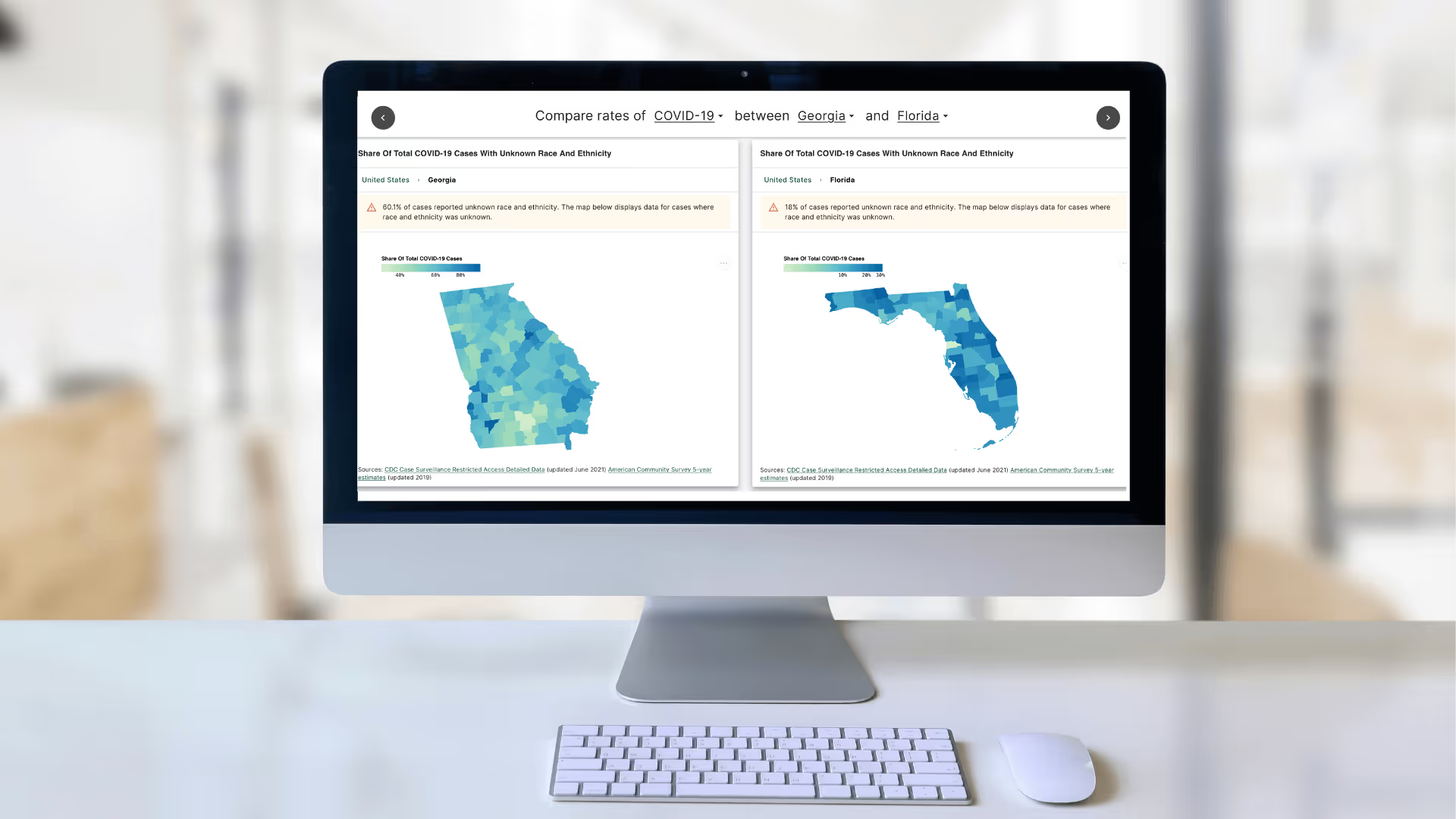
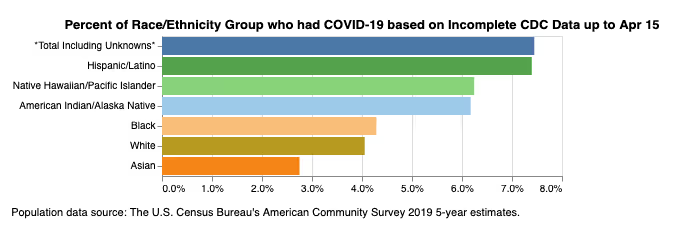
How complete are the CDC's COVID-19 Case Surveillance datasets for race/ethnicity at the state and county levels?

Evaluates the completeness of CDC COVID-19 datasets as a replacement for the Covid Tracking Project, comparing case counts and race/ethnicity data availability.

Oct 12, 2021
by
SHLI Team
COVID-19 Vaccination Data added to SHLI'S Health Equity Tracker

The Satcher Health Leadership Institute's Health Equity Tracker has launched vaccination data as part of its most recent update, highlighting underlying factors contributing to vaccine hesitancy and inequitable vaccine access for historically marginalized communities.

Oct 5, 2021
by
SHLI
Insights into health equity after COVID-19

Dr. David Satcher and Daniel Dawes reflect on how the COVID-19 pandemic highlighted disparities in healthcare access and exacerbated health inequities, particularly for Black Americans who have lost about three years of life expectancy during the pandemic.

Aug 23, 2021
by
Coleen A. Boyle, PhD
Why It Matters That Information On Race, Ethnicity, Gender, And Disability Are Measured Accurately And Completely

Explains how the Affordable Care Act mandated standardized demographic data collection to identify health inequities, and why emergency situations like COVID-19 often result in incomplete reporting.

Aug 23, 2021
by
Kyle R. MacDonald, Danielle Barrasse, and Myrela Bauman
How can we use data to inform practices to advance health equity?

Discusses balancing data collection with community needs, urging public health professionals to examine internal biases while using data responsibly to advance equity.