Dawn M. Hunter, JD, MPH
Director, Southeastern Region
Network for Public Health Law
Early in the COVID-19 pandemic, I would sit in front of my computer screen for hours, riveted by live updates and developments. I waited almost anxiously for daily updates on COVID-19 cases and positivity rates in my home state of Florida. I recently saw an old social media post I shared in June 2020, alarmed that Florida had surpassed 2,000 cases, a record at the time. My life, personally and professionally, revolved around those numbers, and as the data became more clear about who was bearing the greatest burden of cases, hospitalizations, and deaths, so too did the urgency to act.
That is why it was an honor to be a member of the Satcher Health Leadership Institute’s Health Equity Task Force, formed in the fall of 2020 to promote a multidisciplinary and multisector exchange of ideas and expertise to inform the development of the Health Equity Tracker, raise awareness about health disparities, and inform strategies to achieve a more equitable COVID-19 response. Since its launch, the Health Equity Tracker has expanded its data sets to create a more comprehensive picture of health and draw connections across a diverse set of health topics to support transformational change.
Why does the Health Equity Tracker matter?
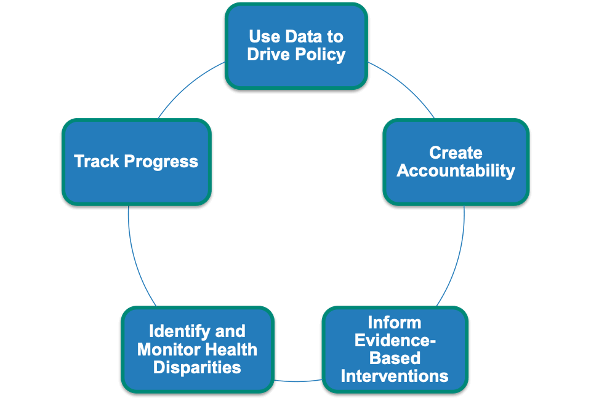
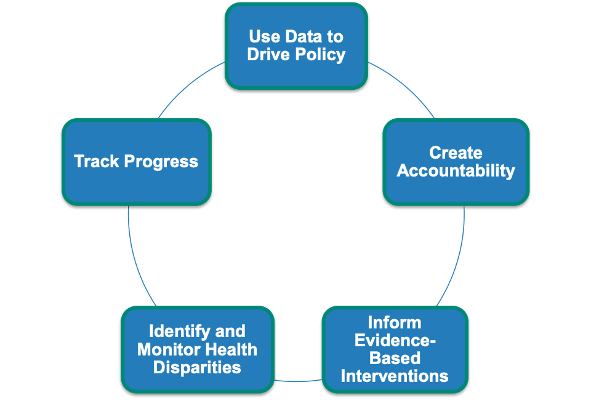
There were two important developments in 2020 that give context to the importance of the Health Equity Tracker: the movement to declare racism a public health crisis, and the creation of COVID-19 Health Equity Task Forces. Between May and November of 2020, nearly 200 declarations were issued in communities across the country. These declarations often cite data on COVID-19 disparities, as well as on disparities in life expectancy and premature mortality, infant mortality, and chronic disease prevalence, and across factors influencing health like education levels and homeownership. Many declarations called for improvements to data collection and use as one of several strategies to achieve racial equity. Some of the common recommendations are highlighted in the figure below:
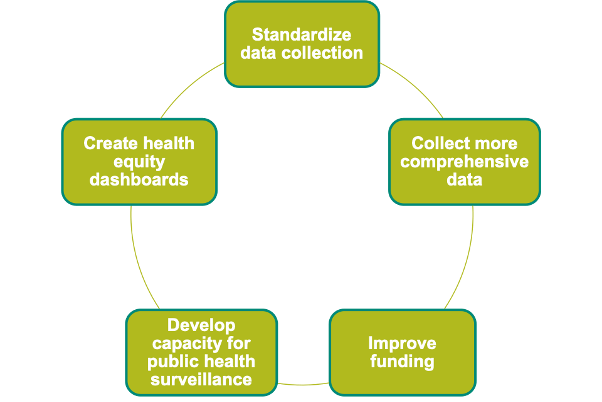
At the same time, state and local governments recognized the need for a more equitable pandemic response, and established task forces to analyze COVID-19 disparities, make recommendations to improve immediate outcomes, and to identify sustainable, long-term changes to improve health equity. My colleague Betsy Lawton and I analyzed task forces in 25 states and numerous cities and counties and identified six key issue areas addressed by task forces along with their top policy recommendations. One of those key issue areas was equitable data practices, and the top policy recommendations were to standardize data collection and collect and report more comprehensive data; improve funding and develop capacity for public health surveillance; and create health equity dashboards to inform the public, drive decision-making, and create accountability.
These findings across declarations of racism as a public health crisis and COVID-19 Health Equity Task Forces were reinforced by the White House’s COVID-19 Health Equity Task Force. This task force started meeting in February 2021, and issued a Final Report and Recommendations and a Proposed Implementation Plan and Accountability Framework in October 2021. One of the five proposed priorities was to “enforce a data ecosystem that promotes equity-driven decision making” with a suggested outcome that “data will accurately represent all populations and their experiences to drive equitable decisions.”
The Health Equity Tracker is a tool to help advance the recommendations that resulted from these declarations and the work of these task forces. It provides a single platform to access and share accurate and relevant data and encourage the use of disaggregated data to perform intersectional analyses of key health topics. Most importantly, the Tracker helps to tell the story not just of COVID-19, but of a broad set of factors that influence our health and wellbeing. It illustrates where we have inequitable outcomes and where more data are needed. We can use the Tracker to help shape the narrative about health equity by having quality, actionable data that we can connect to people and experiences.
Personally, I’m most excited about the addition of political determinants of health data. I study the connection between voter participation and health outcomes, and it’s clear that communities that vote have better health. By voting, we have the power to shape health policy, so it’s important to know where there are gaps in voter participation so that we can identify where we can promote voter education, registration, and turnout.

The Health Equity Tracker is a user-friendly tool to identify health disparities, compare health outcomes, and explore relationships between different health topics. As more data are added, it can paint a robust picture of health equity in the United States and our progress toward a more equitable future. I find the Tracker useful as a tool to empower people with information – the more we know, the better we can advocate for ourselves and our communities.
Learn more about The Network for Public Health Law
Health Equity
COVID-19




.jpg)