
Authored by Turner Jensen under the supervision of Aye Joana Obe, LLM
Introduction
The COVID-19 pandemic highlighted the vast inequities in health and how those inequities can have serious public health and economic consequences. A prime example of this is the experience of essential and frontline workers who are at a significantly higher risk of being exposed to COVID-19. Despite the increased risk of illness and often greater financial need, many jurisdictions do not have laws that guarantee these workers paid sick leave. While the Families First Coronavirus Response Act (FFCRA) was enacted in 2020 to extend these protections to many workers, this policy expired at the end of 2020 and left the states to determine if they want to implement paid sick leave policies.[1] This article will look at the impact of the COVID-19 pandemic on essential and frontline workers, which jurisdictions have adopted paid sick leave policies, and the effects these policies have had so far, illustrating the benefits of implementing similar policies in the future.
Disparities for Essential and Frontline Workers
Initially, it helps to understand who essential and frontline workers are and how the pandemic affected them. Essential workers are employees in industries essential for maintaining critical infrastructure. They represent approximately 82% of the workforce and generally have similar average wages to the rest of the workforce. Frontline workers are similarly diverse to essential workers but have a lower average wage than essential workers and a higher share of minority groups.[2] As disproportionately low-wage earners, many essential workers have additional risk factors like having less access to adequate healthcare and lacking a financial cushion, making it difficult for these employees to miss work when sick.[3] A natural consequence of being unable to take time off when sick is that a sick person is more likely to expose their coworkers to COVID-19 and see their condition worsen.
The effect of the pandemic on these workers was a higher number of infections and deaths. As previously mentioned, minority groups comprise a larger share of frontline workers. Research from 2021 indicates that essential workers who interact with the public have a substantially higher risk of infection than non-essential workers.[4] According to data on the Health Equity Tracker many communities of color experienced COVID-19 infection and death rates that were disproportionate to their share of national and state-level populations.[5]

For instance, Hispanics make up 24.8% of all COVID-19 cases, but only 18.5% of the U.S. population, and Black non-Hispanics represent 12.3% of cases and 12.5% of the total population. Meanwhile, White non-Hispanics comprise 53.5% of cases and 60% of the total population, illustrating a marked difference in health outcomes during the pandemic. [6]
As for mortality figures, Hispanics comprise 17.2%, Black non-Hispanics comprise 13.1%, and White non-Hispanics comprise 63.3%.[7]
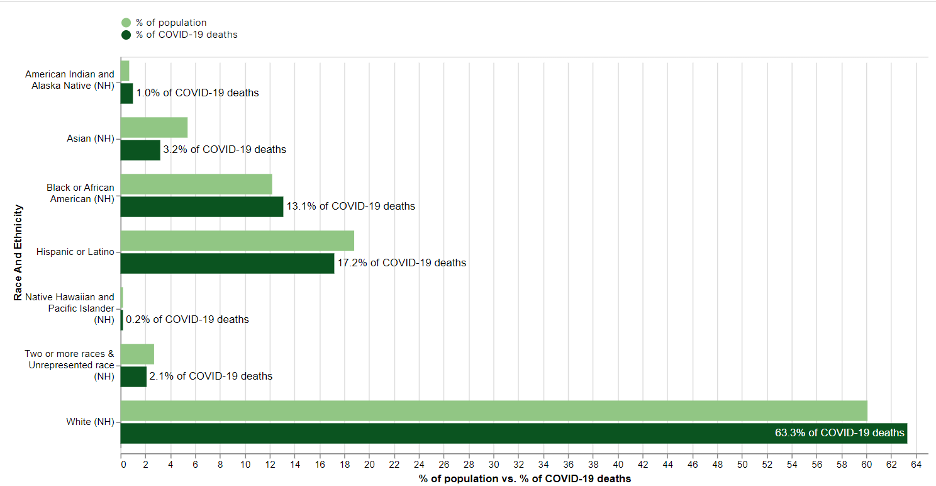
To what extent communities of color comprise the population of essential and frontline workers varies wildly between industries, with White workers constituting the majority in education, Black non-Hispanic workers overrepresented in transportation, and Hispanic workers the majority in grounds cleaning and maintenance, to name a few examples.[8] Low-wage workers are unlikely to have significant savings, making them especially vulnerable to food insecurity if they miss work due to illness.[9]
Naturally, missing work can also negatively impact a household’s ability to afford childcare, rent, healthcare, and other basic expenses. Thus, essential, and frontline workers which were predominantly people of color bore the brunt of the medical and economic consequences of the COVID-19 pandemic.
Implementation of Paid Sick Leave Policies at the State Level
One of the policy decisions in response to the pandemic was the implementation of emergency paid sick leave policies to accommodate sick workers. The percentage of employees in the private sector with access to paid sick leave has slowly increased over time, finally reaching 75% of the workforce in 2020.[10] However, many private sector sick leave policies are restrictive, with most having limited days, no carryover provision, or unlimited accumulation.[11] The FFRCA extended paid sick leave provisions to thousands of employees but was limited in its effectiveness as a result of exemptions that were granted to employers with over 500 employees and less than 50 employees.[12] These exemptions left over 68 million employees without access to paid sick leave, even if they were essential or frontline workers.[13] Millions of vulnerable people were stripped of legal protection as a result.
Following the expiration of the FFCRA, the following jurisdictions have adopted paid sick leave policies: Arizona, California, Colorado, Connecticut, Maine, Maryland, Massachusetts, Michigan, Nevada, New Jersey, New York, Oregon, Rhode Island, Vermont, and Washington, as well as the District of Columbia.[14] The federal Family and Medical Leave Act (FMLA) guarantees unpaid family leaves for the parents of small children, but there are no national standards for paid sick leave or family leave.[15] The jurisdictions that adopted paid family and medical leave are California, Colorado, Connecticut, Maryland, Massachusetts, New Jersey, New York, Oregon, Rhode Island, Washington, and the District of Columbia.[16]
Changes in Health Outcomes
It is clear that essential workers struggled during the pandemic, but what impact did paid sick leave policies have on their health outcomes? Research conducted in 2020 reveals a “statistically significant decrease in the number of reported new COVID-19 cases for states whose workers gained access to paid sick leave as a result of FFCRA.” [17] The evidence also reveals that paid sick leave policies are valuable for reducing the spread of other illnesses in the workplace.[18] These policies can also benefit businesses by keeping employee satisfaction high, making employees less inclined to seek other employment.[19] Paid sick leave policies play a significant role in preventing workers from losing their jobs thereby mitigating national labor shortages.[20] Furthermore, providing sick leave will only cost employers an additional 2.7 cents per worker per hour on average.[21] Deeper research into workers’ experiences from specific industries could also provide valuable insight into the effectiveness of the FFCRA and other paid sick leave policies.
Conclusion
Thus, it is clear that paid sick leave policies have benefited employees and employers. Essential and frontline workers suffered higher than average COVID-19 infections but implementing paid sick leave policies has helped them navigate these challenges and minimize infections and deaths. For communities of color, which have historically experienced unequal access to healthcare and other structural inequities, effective paid sick leave policies will provide a chance to recover from illness without sacrificing their economic or physical well-being. These successes should signal other states to consider adopting similar policies, as no one should have to choose between their health and livelihood.
[1] Mill, J., Frye, J, & Buchanan, M. J. (2022, March 4). Black Women Need Access to Paid Family and Medical Leave. CAP. Retrieved July 20, 2022, from https://www.americanprogress.org/article/black-women-need-access-to-paid-family-and-medical-leave/.
[2] Blau, F. D., Meyerhofer, P. A., & Koebe, J. (2022, March 22). Essential and Frontline Workers in the COVID-19 Crisis (Updated). EconoFact. Retrieved July 19, 2022, from https://econofact.org/essential-and-frontline-workers-in-the-covid-19-crisis.
[3] Wolfe, R., Harknett, K., & Schneider, D. (2021, June 4). Inequalities At Work and The Toll of COVID-19. HealthAffairs. Retrieved July 21, 2022, from https://www.healthaffairs.org/do/10.1377/hpb20210428.863621/full/.
[4] Milligan, W. R., Fuller, Z. L., Agarwal, I., Eisen, M. B., Przeworski, M., & Sella, G. (2022, August 4). Impact of Essential Workers in the Context of Social Distancing for Epidemic Control. PLOS. Retrieved July 21, 2022, from https://journals.plos.org/plosone/article?id=10.1371/journal.pone.0255680.
[5] Investigate the rates of Covid-19 in the United States. (2022, September). Health Equity Tracker. Retrieved October 5, 2022, from https://healthequitytracker.org/exploredata?dt1=covid_cases
[6] Same as 5
[7] Investigate Rates of Covid-19 in the United States. (2022, September). Health Equity Tracker. Retrieved October 5, 2022, from https://healthequitytracker.org/exploredata?dt1=covid_deaths
[8] Rogers, T. N., Rogers, C. R., VanSant-Webb, E., Gu, L. Y., Yan, B., & Qeadan, F. (2020, August 4). Racial Disparities in COVID-19 Mortality Among Essential Workers in the United States. Retrieved July 21, 2022, from https://onlinelibrary.wiley.com/doi/full/10.1002/wmh3.358
[9] Raifman, J. R., Raderman, W., Skinner, A., & Hamad, R. (2021, October 25). Paid Leave Policies Can Help Keep Businesses Open and Food on Workers’ Tables. Health Affairs. Retrieved July 21, 2022, from https://www.healthaffairs.org/do/10.1377/forefront.20211021.197121/.
[10] Bureau of Labor Statistics. (2020). Paid sick leave: What is available to workers? BLS. Retrieved July 21, 2022, from https://www.bls.gov/ncs/ebs/factsheet/paid-sick-leave.htm#
[11] Bureau of Labor Statistics. (2020).
[12] Glynn, S. J. (2020, April 17). Coronavirus Paid Leave Exemptions Exclude Millions of Workers from Coverage. CAP. Retrieved July 27, 2022, from https://www.americanprogress.org/article/coronavirus-paid-leave-exemptions-exclude-millions-workers-coverage/.
[13] Glynn, S. J. (2020, April 17).
[14] Kaiser Family Foundation. (2022). State Policies on Paid Family and Sick Leave. KFF. RetrievedJuly 21, 2022, fromhttps://www.kff.org/other/state-indicator/paid-family-and-sick-leave/?currentTimeframe=0&sortModel=%7B%22colId%22:%22Paid%20Sick%20Leave%22,%22sort%22:%22desc%22%7D
[15] Kaiser Family Foundation. (2022).
[16] Kaiser Family Foundation. (2022).
[17] Pilcher, S., Wen, K., & Ziebarth, N. R. (2022, October 15). COVID-19 Emergency Sick Leave Has Helped Flatten the Curve in the United States. HealthAffairs. Retrieved July 21, 2022, from https://www.healthaffairs.org/doi/10.1377/hlthaff.2020.00863.
[18] Equitable growth. (2020, October 26). Factsheet: New study shows that emergency paid sick leave reduced COVID-19 infections in the United States. Washington Center for Equitable Growth. Retrieved July 21, 2022, from https://equitablegrowth.org/factsheet-new-study-shows-that-emergency-paid-sick-leave-reduced-covid-19-infections-in-the-united-states/.
[19] Schneider, D. & Harknett, K. (2022, April). Good if you can get it: Benefits and inequalities in the expansion of paid sick leave during COVID-19. Federal Reserve Bank of Boston. Retrieved July 21, 2022, from https://www.bostonfed.org/publications/community-development-issue-briefs/2022/good-if-you-can-get-it-benefits-and-inequalities-in-the-expansion-of-paid-sick-leave-during-covid-19.
[20] Maclean, C., Pichler, S., & Ziebarth, N. R. (2022, January 12). Paid sick leave improves public health outcomes and supports U.S. workers at a relatively low cost to employers. Washington Center for Equitable Growth. Retrieved July 27, 2022, from https://docs.google.com/document/d/1cDEjqci7mGxzKy_1Kz-GbRtCexD6uLizm9licqEJ1fs/edit.
[21] Maclean, C., Pichler, S., & Ziebarth, N. R. (2022, January 12).
Health Equity
COVID-19
.jpg)