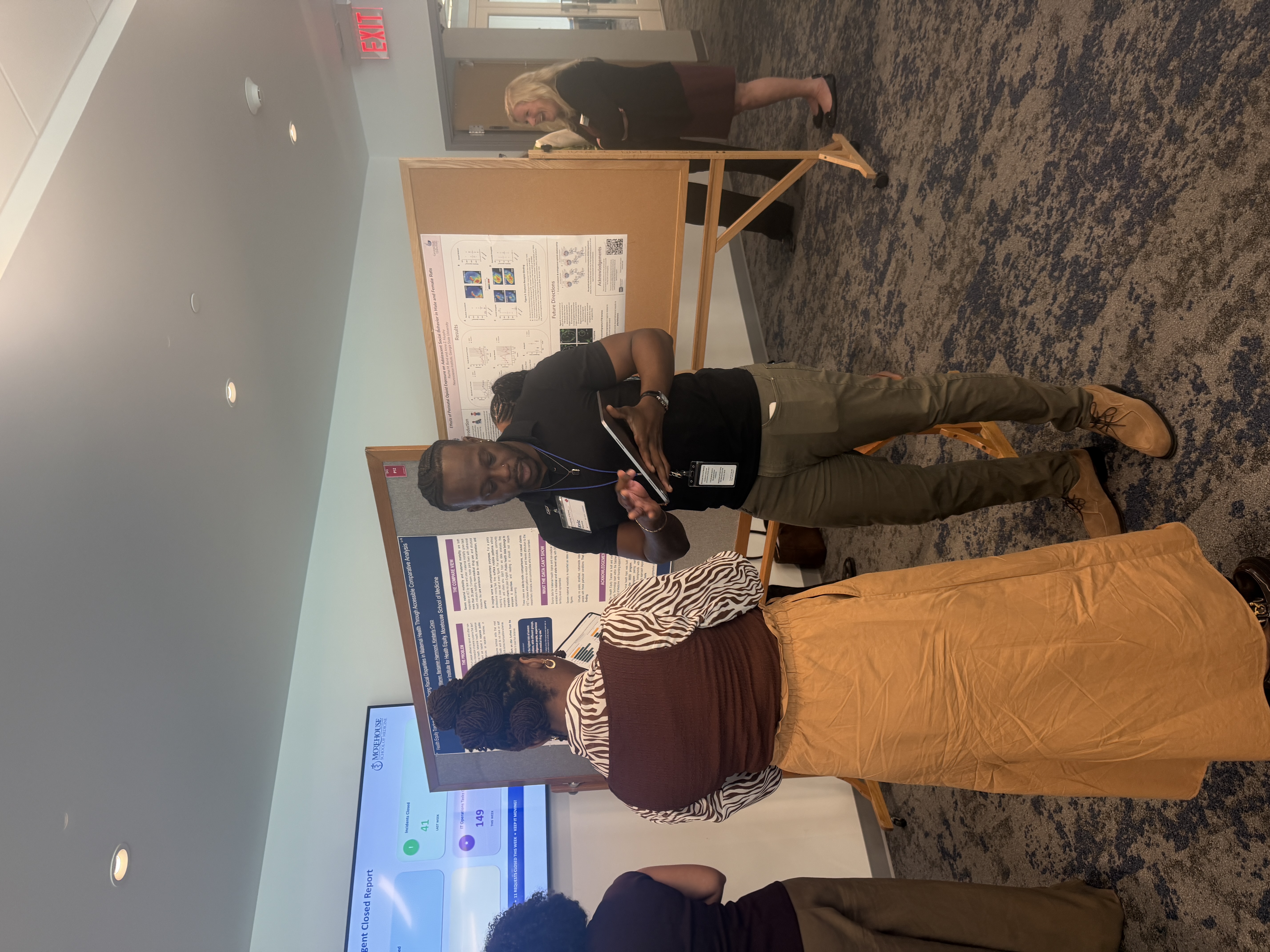
On September 24th, I attended and presented at the Starting Strong Conference: Pregnancy, Opioid Use, and Transforming Systems of Care, hosted here at Morehouse School of Medicine. The conference was organized by Motherhood Beyond Bars, the CORAL Center of Excellence, and MSM. It was led by Dr. Natalie Hernandez-Green, Founding Executive Director of MSM's Center for Maternal Health Equity and Contact PI for CORAL. It brought together clinicians, researchers, treatment providers, policymakers, justice system partners, community organizations, and people with lived experience for a full day centered on one group: women who are pregnant or postpartum and dealing with substance use, incarceration, or both.
These are women who often fall through every crack in the system. The day was set up to bring those cracks into view. There were panels on pregnancy and birth and the continuum of care, on treatment providers working on the front lines, and on policies that choose healing over punishment. The day closed with a session where peers with lived experience told their own stories. I appreciated that the conference didn't just talk about these women. It made room for them to speak for themselves.
The opening keynote came from Dr. Carolyn Sufrin of Johns Hopkins University, an OB-GYN and medical anthropologist. Her talk was titled "Connecting the Cascade of Care: Why Maternal Health Behind Bars Matters for All." Dr. Sufrin has spent her career on reproductive health care for incarcerated people. She once worked as an OB-GYN in the San Francisco County Jails, and she wrote Jailcare: Finding the Safety Net for Women Behind Bars. She also leads Advocacy and Research on Reproductive Wellness of Incarcerated People (ARRWIP) at Johns Hopkins. Her Pregnancy in Prison Statistics (PIPS) study was the first national-scale, systematic look at how often pregnancy happens in prisons and what the outcomes are. Before PIPS, nobody was even counting. That idea stuck with me: you can't fix what you refuse to measure.
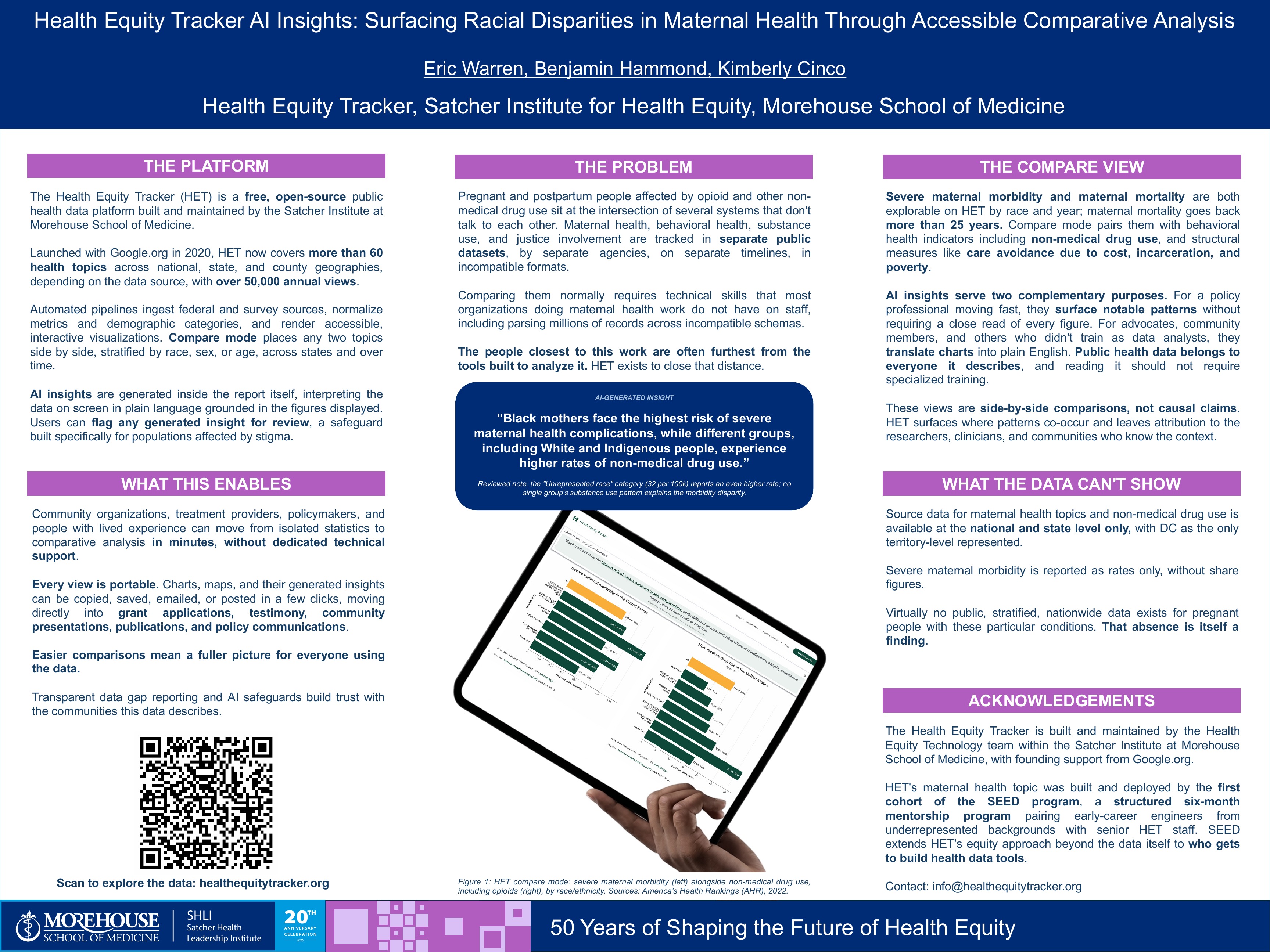
That idea is also at the heart of what we brought to the poster session. I presented our poster, Health Equity Tracker AI Insights: Surfacing Racial Disparities in Maternal Health Through Accessible Comparative Analysis, with my colleagues Benjamin Hammond and Kimberly Cinco. The problem we focused on is one everyone in that room knows well. Maternal health, behavioral health, substance use, and justice involvement are tracked in separate datasets, by separate agencies, on separate timelines, and in incompatible formats. Putting them side by side usually takes technical skills that most organizations doing maternal health work don't have on staff. The people closest to this work are often furthest from the tools built to analyze it.
The Health Equity Tracker (HET) is our attempt to close that distance. HET is free and open source, launched with Google.org in 2020. It now covers more than 60 health topics and gets over 50,000 views a year. In compare mode, users can put severe maternal morbidity or maternal mortality (which goes back more than 25 years) next to indicators like non-medical drug use, incarceration, poverty, and avoiding care because of cost, broken down by race. Our AI insights then explain what's on screen in plain English. Using America's Health Rankings data, for example, the insight showed that Black mothers face the highest risk of severe maternal complications, while other groups, including White and Indigenous people, have higher rates of non-medical drug use. In other words, substance use patterns alone don't explain the disparity. Because the populations described here face so much stigma, users can flag any generated insight for review.
We were also upfront about what the data can't show. Maternal health and drug use data are only available at the national and state levels. And there is almost no public, stratified, nationwide data for pregnant people living with these conditions. That absence is a finding in itself, and after hearing Dr. Sufrin's keynote, it felt even more urgent.
I'm also proud that HET's maternal health topic was built and deployed by the first cohort of our Software Engineering and Education Development (SEED) program. Those early-career engineers came from underrepresented backgrounds. Equity isn't only about the data we show. It's also about who gets to build the tools.
Starting Strong reminded me that every number on a dashboard is a mother, a baby, and a family trying to make it through systems that weren't designed with them in mind. Our job is to make sure the data meets them where they are.
.jpg)